

Over the past month, I’ve been back in the silt and shadows of my short story, “Wet Air,” revising it for submission.
I love the editing stage; the architecture is finally there on the page, and now it’s a matter of refining the mechanics of the prose. It’s a pursuit of a very specific flow state—one where the technical and the psychological finally align.
The most compelling aspect of revision is its steep, unavoidable learning curve—a space where I’m perpetually discovering new dimensions of the craft and my own artistic identity. My MFA taught me exactly how much I have yet to learn about writing, a realization that is both devastating and thrilling.
Rather than succumbing to self-deprecation—that hollow vacuum of “knowing nothing”—I’ve chosen to embrace the curiosity as it tethers itself to my stride on every mile of the trail, occupying the shaded recesses of my mind deep into the night. Every fracture in a draft is an opportunity to etch new fissures into my spongy writer brain, and I am learning to welcome the weight of it.
POV as a Psychological Tool
I have long grappled with Point of View—a struggle my MFA advisors and workshop cohorts can certainly attest to. However, during the revision of “Wet Air,” I realized my difficulty was of a conceptual breed, one that shifted my focus away from the ambiguity of “vibes” and toward a more urgent objective.
Perhaps POV isn’t merely a technical setting; it is a psychological tool. And the goal? To capture an accurate and visceral representation of a traumatized consciousness.
The Title & POV Shift
In earlier drafts of “Wet Air” (then titled “Mirror Pond”), I relied on a traditional Close Third POV that positioned the narrative as a witness to the suffering of my protagonist, Thomas. But as the revision progressed, I realized the story had outgrown its name.
The shift was symptomatic: a mirror is something you look at from a distance, but wet air is something you breathe in.

To truly represent what theorist Cathy Caruth calls the “unclaimed experience”—the way trauma bypasses the intellect and strikes the body directly—I had to move into Deep Third.
The story could no longer be about a boy getting hit; it had to be about the anatomy of the hit itself.
Reader as “Co-Owner” of Trauma
I am obsessed with reader immersion and the intentional collapse of Narrative Distance. My goal in “Wet Air” is to close the gap so entirely that the reader becomes a “co-owner” of the trauma.
This approach operates within the testimonial framework developed by Shoshana Felman and Dori Laub—a concept I explore deeply through a creative lens in my craft essay, “Disrupting the Narrative: The Reader as ‘Co-Owner’ of Trauma.”

To achieve this, I utilize a technique I call Neurological Reporting—an intent-driven strategy that maps the clinical reality of trauma-induced dissociation.
In Deep Third POV, this requires stripping away the “observer.” Instead of adding filtering verbs—“He felt the cold water”—which positions a narrator between the character and the sensation, we might write: “The water sizzled against his skin.” Here, the reader is no longer watching a character experience a stimulus; they are experiencing the stimulus alongside the character’s nervous system.
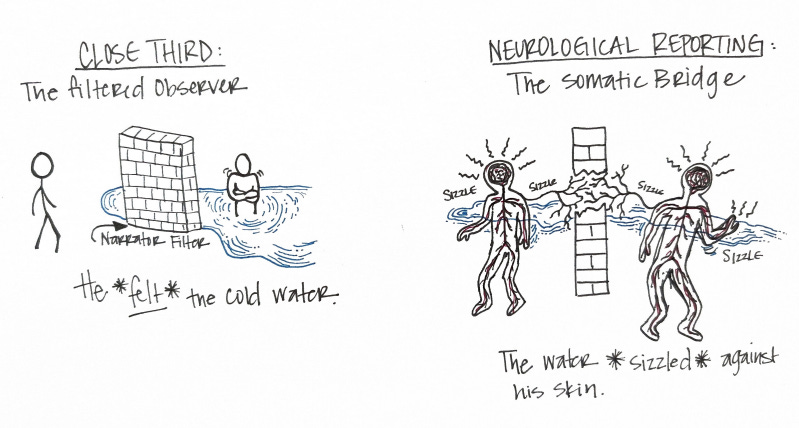
Note: I promise my prose is more refined than my sketches. I’m a writer, not an illustrator—clearly—but sometimes the anatomy of a theory requires a literal skeleton to make the brain-science stick.
Neurological Reporting in Practice
Compare the evolution of these scenes from my original draft, “Mirror Pond,” to the revised “Wet Air.”
Example 1: The Anatomy of the Hit
Original (The Report): “The instant he broke the surface for air, Sam’s father tackled him, clocking him in the face. A sickening crunch echoed across the water, followed by a searing pain up the side of his right cheek.”
Revision (The Experience): “The instant he broke the surface, a brute force tackled him, smashing his face. A crunch detonated within his skull. The flat, wet click of a stone hitting a peach. Sharp heat scalded his right cheek . . .”
The Insight: In the original draft, Thomas is an observer of his own assault. He identifies the attacker immediately and hears the crunch “across the water.”
In reality, a concussed brain doesn’t identify the attacker; it registers “brute force.” It doesn’t hear an external echo; the sound “detonates within the skull.” By removing the narrator’s analytical filter, we move from witnessing a boy get hit to experiencing the anatomy of the hit itself.
Example 2: The Dissociative Drift (Filter Removal)
Original (The Report): “Through the pain, Thomas felt disconnected, undone. What had been a day bursting with color only moments before was quickly slipping away as his world began to fade. Sound went first . . .”
Revision (The Experience): “The day went thin. Colors leached into ash as a cold, ringing hum rose from the base of his skull, drowning out the man’s roar. The pulp-red smear of the pond bleached into a flat, blinding white . . . It began to snow.”
The Insight: In the original, the narrator is a clinical reporter, carefully cataloging the order of operations—“Sound went first”—for the reader’s benefit.
In the revision, there is no reporter. I removed the filter verbs (“Thomas felt”) and replaced the description of sound loss with the presence of a “ringing hum” that drowns out reality. The narrative “self” has evaporated; there is no one left to observe the fade, only the biological reality of the ash, the hum, and the bleaching of the pond.
The prose is not describing dissociation; it is performing it.
The Unified Shift: From Reporter to Nervous System
In these examples, the transition is clear. By identifying the impact as “brute force” (Example 1) and stripping away the mediation of filter verbs (Example 2), the narrative stops acting as a witness and starts acting as a nervous system.
This technical grounding allows for the creation of what I’m calling Somatic Loops.
The Architecture of the Loop
If Neurological Reporting is the intent, Somatic Loops are the structural framework—recurring physical sensations that trap both the character and the reader in a cycle of physiological response.
This aligns with Somatic Experiencing® Theory, which posits that trauma is “stored” in the body’s tissues rather than its memory banks, becoming part of a somatic archive.
By using a specific sensory anchor that repeats, I can tighten the “closed circuit” of the scene. In “Wet Air,” the “click of a stone hitting a peach” (Example 1) is the start of the loop. It is a sensory anchor that bypasses logic and strikes the reader’s nervous system directly. This loop is fulfilled by the “pulp-red smear” (Example 2)—the completion of the circuit.
The Final Insight: Closing the Circuit
By revisiting the “pulp-red smear,” I trigger a sympathetic response to the initial “click” of the bone. The reader’s brain is compelled to make a biological connection between the sound of the impact and the eventual failure of the vision.
This is the “anatomy of the hit”—the transition from a story about trauma to a narrative that functions as trauma.
The reader is no longer being told that Thomas is remembering; the language has already performed the somatic recall within their own nervous system.
The circuit is closed.
Conclusion: Structural Inevitability
In the Eco-Gothic tradition, the landscape often rises to fill the vacuum left by a fractured psyche.
By using Deep Third, I was able to show the exact moment Thomas’s “self” was erased. As his internal narrative fails, the environment—anchored by sensory details like “wet air,” the “indigo silt,” and the “last, heavy drink”—takes over as the primary agent of the story.
When Thomas finally surrenders to the water, it isn’t a “character choice;” it is a structural inevitability.
The Deep Third POV allows the reader to experience this not as a tragedy they are watching from the dock, but as a drowning they feel in their own lungs.
